


An Environmentally Safe Production of Xylanases by Fusarium sp. EA 1.3.1 Using Agroindustrial Residues: Biochemical Characterization and Potential Applications
Gessica O. Marinho
Instituto de Ciência e Tecnologia, Universidade Federal dos Vales do Jequitinhonha e Mucuri (UFVJM) campus JK, Diamantina, MG 39100-000, Brasil.
Eloísa A. Nogueira
Instituto de Ciência e Tecnologia, Universidade Federal dos Vales do Jequitinhonha e Mucuri (UFVJM) campus JK, Diamantina, MG 39100-000, Brasil.
Thiago Machado Pasin
*

Department of Chemistry, University of Texas at San Antonio, One UTSA Circle, San Antonio, Texas 78249, United States.
Tássio Brito de Oliveira
Departamento de Ecologia e Sistematica, Centro de Ciencias Exatas e da Natureza, Universidade Federal da Paraiba (UFPB), João Pessoa - PB, 58051-900, Brasil.
Juan Pedro Bretas Roa
Instituto de Ciência e Tecnologia, Universidade Federal dos Vales do Jequitinhonha e Mucuri (UFVJM) campus JK, Diamantina, MG 39100-000, Brasil.
David Lee Nelson
Instituto de Ciência e Tecnologia, Universidade Federal dos Vales do Jequitinhonha e Mucuri (UFVJM) campus JK, Diamantina, MG 39100-000, Brasil.
Vivian M. Benassi
Instituto de Ciência e Tecnologia, Universidade Federal dos Vales do Jequitinhonha e Mucuri (UFVJM) campus JK, Diamantina, MG 39100-000, Brasil.
*Author to whom correspondence should be addressed.
Abstract
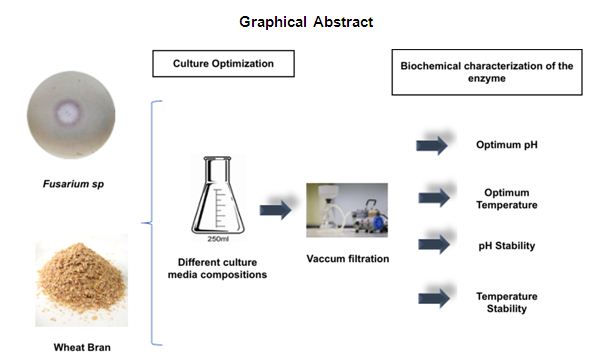
Renewable energy-related biotechnologies such as biofuels produced from low-cost residual sources that represent clean technologies have become a partial solution to environmental problems. We sought to optimize the cultivation parameters of the fungus Fusarium sp. EA1.3.1 and biochemically characterize the naturally produced xylanases from the fungus. The development of the fungus was analyzed considering the variations in the resources available and by biochemical analysis of the crude extract. The composition and duration of the cultivation, nitrogen source, carbon source, salt solution, and initial pH of the medium were evaluated. The maximum xylanolytic production was obtained in Khanna medium enriched with a CP salts solution during four days of culture using yeast extract, wheat bran, and an initial pH of 8.5 for the culture medium. The optimum temperature and pH were 65°C and 6.5, respectively, for the xylanase activity from Fusarium sp. EA 1.3.1. The enzymatic extract presented general stability at 50°C, keeping 75% of its activity after 90 minutes of incubation, and its activity decreased to 20-40% with exposure to higher temperatures (60-70°C). The enzyme also presented high stability at pH 5.0 after 90 minutes, maintaining 85% of its relative activity. Thus, the isolated fungus presents high potential for xylanase production with desired biochemical and biophysical properties for industrial application.
Keywords: Fusarium sp, xylanases, agroindustrial residues